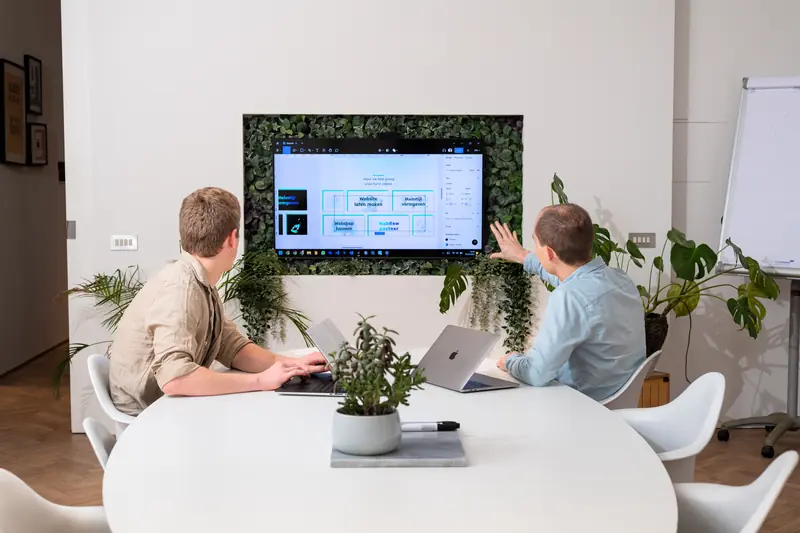
Today you can visualise a website idea in an afternoon with Wix, Framer, or ChatGPT. That is useful — especially in the idea phase when you want to explore direction, structure, or visuals.
But an idea is not yet a live business website. Going live requires domain, email, hosting, responsive design, forms, SEO basics, and ongoing management. That often takes 40–120 hours — on top of your normal work.
If you search for cheap website development, free website builder, or can ChatGPT build a website, you are actually comparing three things: money, time, and responsibility. This guide helps you make that choice soberly.
Idea phase vs. going live
| Phase | DIY / AI builder | Agency (upshift) |
|---|---|---|
| Exploring structure | ✅ Useful | ✅ In intake |
| Visual prototype | ✅ Fast | ✅ In design phase |
| Domain + email | ❌ Arrange yourself | ✅ Included |
| SEO technical setup | ⚠️ Limited | ✅ Basics included |
| Ongoing management | ❌ Yourself | ✅ ±€25/mo hosting |
| Time investment | 40–120h+ | 4–8 week project |
When DIY makes sense
- You only want to test an idea, not a commercial site yet
- Budget is truly zero and you have time
- Your site is purely informational with no conversion goal
When hiring an agency makes more sense
- Your website needs to generate enquiries
- You do not have 40–120 hours to spare
- You want to be found in Google (and increasingly in AI search)
- You have already tried Wix and it does not scale
Can ChatGPT build my website?
AI is strong at copy, structure, and first drafts. It is weaker at:
- Responsive design on all devices
- Forms, hosting, SSL, DNS
- Technical SEO (sitemap, metadata, performance)
- Ongoing maintenance
We use AI internally where it helps — but the site that goes live is built by people who take responsibility for the result.
Can ChatGPT build a website for free?
ChatGPT can help for free or cheap with ideas, copy, sitemap proposals, code examples, and initial design choices. But ChatGPT does not automatically publish a reliable business website with domain, hosting, email, forms, analytics, privacy, responsive QA, and maintenance.
The real cost is therefore not only in generating pages. The real cost is in deciding, checking, going live, and keeping it managed.
Can I have AI build a website?
Yes, AI builders can set up a first website. That is handy when you want to test something quickly or when the site carries little commercial pressure.
For an SME site that needs to generate enquiries, these questions remain important:
- is the positioning correct?
- is the copy credible and specific?
- is the site fast on mobile?
- are forms, tracking, and metadata set up correctly?
- is the structure suitable for SEO?
- who fixes problems after launch?
AI speeds up parts of the process. It does not remove responsibility for the end result.
Which software is best for building a website?
That depends on the role of your website.
| Software | Makes sense when | Watch out for |
|---|---|---|
| Wix or Squarespace | You want to go online quickly and cheaply | Limited scalability and SEO control |
| Framer or Webflow | Visual marketing pages matter | Platform costs and management choices |
| WordPress | You want to manage lots of content yourself | Maintenance, plugins, and security |
| Next.js or custom | Performance, SEO, and custom work matter | You need technical guidance |
Software is not a strategy. Even with good software, you still need to choose which pages you need, which search questions you answer, and how visitors get in touch.
Can you build a website yourself for free?
Technically you can start for free, but a free website almost always has hidden costs: your own time, limited domain options, limited SEO, less trust, platform branding, or extra costs once you want to look more professional.
Free makes sense for a test, hobby project, or very early idea phase. For a business that needs trust and enquiries, "free" often becomes expensive when you have to rework everything later.
Cheap website development: when is that smart?
Having a cheap website built can be smart if your scope is small and your expectations are realistic. Always ask what is not included.
Pay particular attention to:
- SEO basics and metadata
- mobile design
- copy and structure
- hosting and domain
- post-launch support
- monthly costs
A low entry price without these elements can look good, but later cost more through missed enquiries or technical rework.
Our approach
At upshift, a compact website starts from €4,000. No template lock-in, direct contact with the makers, SEO basics, and clear agreements around launch. First call: 20 minutes, no obligation.
Compare options on our website development service page, calculate a ballpark with the pricing calculator, or read what a website costs in Belgium.